Showing posts with label Internet. Show all posts

Saturday, February 22, 2014

Julian Assange Takes Space


Julian Assange dancing in Reykavik in 2011.

"It was Evelyn Waugh who said that when a writer is born into a family the family is over. And why would it be any different when a second family comes to call? Julian wanted a brother, a friend, a PR guru, a chief of staff, a speechwriter, and he wanted that person to be a writer with a reputation. When he was working with those fellows from the Guardian, the New York Times and Der Spiegel, he allowed himself to forget that they were journalists with decades of experience and their own fund of beliefs. To him they were just conduits and possible disciples: he is still reeling, even today, from the shock that they were their own men and women. My discussions with him would go on, in private, long after the idea of ‘collaboration’ was over. But he consistently forgot that I am foremost a writer and an independent person. Julian is an actor who believes all the lines in the play are there to feed his lines; that none of the other lives is substantial in itself. People have inferred from this kind of thing that he has Asperger’s syndrome and they could be right. He sees every idea as a mere spark from a fire in his own mind. That way madness lies, of course, and the extent of Julian’s lying convinced me that he is probably a little mad, sad and bad, for all the glory of WikiLeaks as a project. For me, the clarifying moment in our relationship came when he so desperately wanted me to join him on the helicopter flight to Hay. He wanted me to see him on the helicopter and he wanted me to assist him in living out that version of himself. The fact he was going to a book festival to talk about a book we both knew he would never produce was immaterial: he was flying in from Neverland with his own personal J.M. Barrie. What could be nicer for the lost boy of Queensland with his silver hair and his sense that the world of adults is no real place for him? By refusing the helicopter I was not refusing that side of him, only allowing myself the distance to see it clearly for what it was. And to see myself clearly, too: I have had to fight to grow away from my own lost boy, and it seemed right that day to fly a kite with my daughter and retain my independence from this man’s confused dream of himself." - Ghosting by Andrew O'Hagan
The great tragedy of Julian Assange and Wikileaks is that they have become one in the same thing. The role of Wikileaks is now the life of Assange. In 2010 when the heat was closing in, Assange should have set up an administrative panel to manage the organization and then continued to fight his own battles independent of the function of Wikileaks. By reading Ghosting by Andrew O'Hagan we gain insight into why this would never have happened. Assange is brilliant, but his poor skills with people and how his own fears and obsessions dominate the decision making processes of the organization result in a spectacle driven series of explosive revelations. 

"One of the issues that bugged me was how far all this had taken us from the work WikiLeaks had started out doing. I believed at this stage that the organisation could regroup after the legal appeals and the autobiography battle, returning to the core work that had made Julian’s name. But there was strong evidence now that he was devoted to his legal problems as well as to skirmishes with former collaborators over his reputation" - Ghosting by Andrew O'Hagan.

The entrance of personality into journalism is journalism at its lowest level. The most obvious similar example, and one from a very different sphere than Wikileaks is News of the World. Reputation and publishing are tied together, but like The Economist, there is no reason for this to be centered on individuals. Even mainstream traditional publishing can be done anonymously right through to the point of readership. The name of the publication is enough to ensure reputation.

By breaking his confidentiality, O'Hagan delivers a fascinating portrait of Assange. No matter what happens in the future, Julian's role in the history of digital media is assured. However, by making himself the public face of Wikileaks, Assange opened himself up to exactly the sort of scrutiny and critique that O'Hagan delivers. Thus the tragedy of Assange is the tragedy of Narcissus:

Narcissus is the most beautiful boy whom many have ever seen, but he does not return anyone’s affections. One of the disappointed nymphs prays to the god of anger, Nemesis, that "he who loves not others love himself." Nemesis answers this prayer. Narcissus looks at his own reflection in a river and suddenly falls in love with himself. He can think of nothing and no one else. He pines away, leaning perpetually over the pool, until finally he perishes.

Information waits for no man and unless Assange can redefine himself in the contexts of more recent and less personality driven acts related to information, power and access (i.e. Manning, Snowden), he is in danger of becoming a figure in a digital mythology that warns against rather than inspires. O'Hagan comes to a similar conclusion when he writes, "WikiLeaks should not only bale stuff out onto the web, but should then facilitate the editing and presenting of that work in a way that was of permanent historical value". I believe it is too late for this now, and unless Assange can extricate himself from his present situation and rebuild trust with his key allies and the broader community of digital information activists, then his enemies (and he has so many of them) have won. The defeat of this Narcissus would be no victory for the people trying to make sense of the global digital pool we all now live in. Freedom is under threat, as Chelsea Manning writes in her Sam Adams Award Acceptance Speech, Feb 2014;

"When the public lacks the ability to access what its government is doing, it ceases to be involved in the governing process. There is a distinct difference between citizens, in which people are entitled to rights and privileges protected by and from the state, and subjects, in which people are placed under the absolute authority and control of the state. In essence, this is the difference between tyranny and freedom. To echo a maxim from Milton and Foes Friedman: a society that puts secrecy - in the sense of state secrecy - ahead of transparency and accountability will end up neither secure nor free."

The stakes are that high. Assange has to understand that what he has voluntarily taken on in his 'job' is so important that he no longer matters as an individual, no matter how painful and difficult that realization is. It seems Chelsea Manning is aware of that as her present defiance indicates while still languishing in prison.

Thursday, June 13, 2013

The Surveilled Imagination – A World Watched to Make Information


NSA Whistleblower Edward Snowden speaks about his leaking of information about PRISM

This is a short essay on surveillance as commodity acquisition and the social contract. I have been following the story of PRISM, which according to the United States Army Field Manual, as quoted by Mother Jones, is
“A subsystem of collection management mission application, is a Web-based management and synchronization tool used to maximize the efficiency and effectiveness of theater operations. PRISM creates a collaborative environment for resource managers, collection managers, exploitation managers and customers”.
Based on information leaked by Edward Snowden, a former contracted manager for the National Security Association, PRISM is used to collect and monitor information from millions of people inside and outside of the United States of America. Unless you have been offline over the past week, you have probably heard about this, as it is just beginning to have consequences, due largely to the extent of the allegations and the time it took for most governments and public figures to understand precisely what the PRISM Leak means. It means so much and could be of such far-reaching consequences that many of the departments and institutions responsible for this sort of knowledge were initially silent, presumably trying to fathom it. One of the more intelligent speculations I saw about PRISM was from Guy Verhofstadt, President of the Alliance of Liberals and Democrats for Europe (ALDE) Group in the European Parliament. Guy tweeted;
“#prism How has data been used and is it in conflict with EU data protection? The Commission, best @BarrosoEU must answer this at next #EP”
I am sure Mr Barrosso is looking into it right now. This is just the tip of the iceberg when it comes to PRISM. But I want to back off slightly from the revelations of PRISM to what it means in broader terms. I want to ask here, what is the reality of surveillance? I mean mass surveillance; "the pervasive surveillance of an entire population, or a substantial fraction thereof" (Wikileaks).

I started following the developments around the PRISM leak on Twitter as they were published on The Guardian website. I noticed this tweet from Mark Vanderbeeken (Senior partner at Experientia and editor of Putting People First, Turin, Italy);
“But is it actually possible to return to a non-surveillance world? The genie is now out of the bottle”
I replied to Mark that it is not possible to 'go back' to an imagined "non-surveillance world" (if that ever existed); but what we are actually witnessing today is the process of shifting power and control under the auspices of digital technology and the mass surveillance it makes possible. In writing this I thought particularly of the life of Christopher Marlowe, the famous playwright and contemporary of Shakespeare. Marlowe was at the center of a surveilled society, a society which was undergoing dramatic changes. Marlowe worked as a spy, and was also the subject for surveillance, dying at the age of 29 in 1593 as a result of an altercation in an inn under suspicious circumstances.

Up to his eyeball in surveillance; Christopher Marlowe 1564-1593 (spy poet trouble maker)

Surveillance today is beyond anything Marlowe could have imagined even in his most extravagant stage drama. With a massive digital network of communication, mediation and simulation now well established around the planet, it is possible to gather information about people at a level of detail unparalleled in human history. Many nation states are now spying on their general populations. Information is collected en masse and stored not for individual identification, but to construct patterning in the population. Mass information is about demographics, trends, movements on a large scale towards ideas, issues or cultural trends. At the same time individual privacy is no longer possible for anyone that uses digital media, although encryption such as Tor does hide connections between people and sites online.

"The expansion in the use of surveillance represents one of the most significant changes in the life of the nation since the end of the Second World War. Mass surveillance has the potential to erode privacy. As privacy is an essential prerequisite to the exercise of individual freedom, its erosion weakens the constitutional foundations on which democracy and good governance have traditionally been based in this country." -  United Kingdom House of Lords Constitution Committee, "Surveillance: Citizens and the State" (2009)
I returned to Twitter, filled with ideas about what mass surveillance was doing to our societies. If the constant unmonitored gathering of information by the public and private security industry ("70% of the intelligent budget of the USA today goes to private contractors like Booz Allen" -whistleblower Chris Pyle) is damaging democracy and individual freedom, what else it is doing? I dug up my favorite theorists when it comes to information and the body politico in a globalized interconnected 24-hour digital society. I see the perceived need for surveillance as part of the "deterritorialization of production" (Negri & Hardt) and this can be transparent or opaque. All are networks monitored and this includes production. Surveillance creates what is one of the most valuable resources of the 21st Century, information. Mark Getty, chairman of Getty Images, once said, "Intellectual Property is the oil of the 21st century". I believe surveillance is the State using the tools at its disposal to create a vast resource. So the problem with surveillance is structural. Information is resource. Value is added by scarcity, effect and processing. In this sense surveillance is monopolistic as it can only be created on a mass scale by a level of infrastructure that has a budget of governmental proportions. I could spy on my neighbors, or even a town, but it could not be used in any meaningful way and besides it is illegal. The government on the other hand is already doing this and a lot more.

Many citizens believe it is necessary to be surveilled. Paul Sheehan, a columnist for the Sydney Morning Herald in Australia wrote that the problem for those seeing Edward Snowden’s leaking of information about PRISM as a heroic act based their assessment on  “The final inconvenient fact is a practical one: all government agencies except the tax department do not have the time, the resources, or the interest to examine the activities of private citizens without good reason. Most of us are of no interest to the government unless we are doing something dangerous to others. Paranoia is invariably self-absorption” – (Tuesday 11 June 2013). With his use of Newspeak ('Paranoia is invariably self-absorption'), Sheehan totally misses the concept of information as a resource. What if information is not gathered to catch the feared ‘bad guys’ but in order to create something of value? If this is so we have to ask how the subjects that are surveilled contribute to the creation of this value. The government does not have the ability or interest in monitoring the daily activities of the majority of the population. But it does have an interesting in monitoring mass opinion, demographic behaviors and cultural shifts that occur in the governed population. This is largely done without the consent of the people. While laws are introduced to contain and combat security threats, the same legislation used to create these laws can be used to create the ‘oil of the 21st Century’.

The most worrying possibility is that the leaks we are seeing now are not particularly relevant to the security apparatus, that these low-level figures in the system releasing information are actually playing into the argument for a greater degree of security and monitoring and as a result there will be tighter controls and less transparency in the future. The news of PRISM was first broken in May 2006 by Walter Pincus writing for USA Today

"Disclosed that the NSA "has been secretly collecting the phone call records of tens of millions of Americans, using data provided by AT&T, Verizon and BellSouth," attributing that information to "people with direct knowledge of the arrangement." The newspaper continued: "The NSA program reaches into homes and businesses across the nation by amassing information about the calls of ordinary Americans - most of whom aren't suspected of any crime. This program does not involve the NSA listening to or recording conversations. But the spy agency is using the data to analyze calling patterns in an effort to detect terrorist activity, sources said in separate interviews."
Today Pincus is writing about a history of surveillance in the USA, but few people seem to be paying attention to him then or now. Pincus states "It is worth noting that two days after the USA Today disclosure, a Washington Post poll showed that 63 percent of those polled said it was acceptable for the government to collect tens of millions of phone records, while 35 percent considered that unacceptable."

Mass surveillance contravenes the social contract, as an infringement upon the right of the sovereignty (the people) to full disclosure of the body politic;

"Rousseau emphasizes that the general will exists to protect individuals against the mass, not to require them to be sacrificed to it. He is, of course, sharply aware that men have selfish and sectional interests which will lead them to try to oppress others. It is for this reason that loyalty to the good of all alike must be a supreme (although not exclusive) commitment by everyone, not only if a truly general will is to be heeded but also if it is to be formulated successfully in the first place" - Entry, "Rousseau" in the Routelege Encyclopedia of Philosophy, Edward Craig, editor, Volume Eight, p. 371
For this reason there must be disclosure in order for democracy to be restored to those countries currently operating secret mass intelligence networks against their own citizens. The PRISM affair can be argued to be an attempt by one man to manifest disclosure. This is an idea shared by others. Dean and Professor of Law at the National University of Singapore Simon Chesterman writes in One Nation Under Surveillance – A New Social Contract to Defend Freedom Without Sacrificing Liberty (Oxford 2011) of a need for a “new social contract” that should be characterized by three principles:

(1) The intelligence powers exercised must be public,
(2) The entities carrying out these functions must be legal, and
(3) Accountability for activities of intelligence services must be consequence-sensitive (as opposed to having the aim of deterring or responding to abuse) (See Dreier).

These three additions to the Social Contract will change the nature and affect of mass surveillance on society. However, if the reason behind the mass surveillance that has developed in many nations is because of the value of information then there is unlikely to be a change in relation to the social contact. It is at this point we must consider the role of capitalist ideology in mass surveillance. If "Intellectual Property is the oil of the 21st century" then the masses of information gathered on the public is valuable. If surveillance is made public, legal (i.e. a result of due process), and driven by consequences then it will cease to have the same value according to commodity relations (i.e. scarcity, processing into tangible goods etc.). It is at this point I consider we are now at a crossroads for the continuation of the human project. How we move forward on this question will alter the community of the species.


One Nation Under Surveillance: A New Social Contract with Simon Chesterman (click on image)

There will always be surveillance and in an age where information is as valuable as oil there will only ever be more. But can information produced by surveillance be used for bettering society rather than controlling the more radical/progressive (depending on your perspectives) elements? Instead of using surveillance to create ‘security’ alone we could be using this information to organize community action, make free media for people to use, creating databases for culture, art, and knowledge. If we can collect the data from the phone calls people make, why can’t we make a system where information is shared for knowledge, art, science and research, social development and solidarity? This is a surveillance system that would take the forms of open information, universal access, networked and self-organizing systems run by users.

Tuesday, May 07, 2013

The Online Letter Archive

The online letter archive seems to be a popular project for humanities researchers. Such archives offer the correspondences of either a well known individual, or of people who experienced a historical event and wrote letters about it. The online archive is a model for the digital organization of of a collection and a brief survey of a few current online letter archives reveals some interesting tendencies, features and limitations to the present format.


The Darwin Correspondence Project (DCP) "exists to publish the definitive edition of letters to and from Charles Darwin". The site promises; "you can read and search the full texts of more than 7,000 of Charles Darwin’s letters, and find information on 8,000 more. Available here are complete transcripts of all known letters Darwin wrote and received up to the year 1868. More are being added all the time."With such a vast amount of material an efficient search system is essential. The basic search system on DCP is keyword motivated. As such it is an efficient but limited system. For example, in the general search window, by searching for the keyword "Galapagos" it returns 170 entries. More fine-grained search is available, with a) People, b) Places, c) Keyword (with four fields available; 1. All Content, 2. Only Summary, 3. Only Transcript, 4. Only Footnote) and finally d) Time Range. Entering "Galapagos" in the Places field only returns 59 entries; which seems odd. There is no graphical interface available (that I could find anyway) on the site for place correlation, such as a map that imposes time over place, to see some progression in the movements of Darwin, and thus connecting the letters together in another searchable field (i.e. place). There are a number of glossaries in the website for DCP, the most interesting of which is perhaps the Physical Descriptions. Here the original artefacts are coded according to genre and materiality (eg. original, handwritten, condition status etc). The coding of genre and materiality is an efficient way to present something of the objects it is representing, but it would be good to have seen at least some scans. There is however the Darwin Behind the Scenes virtual exhibition, which is linked from the site on the News section, where you can see high resolution images of some of the objects. Searching for Galapagos on the Behind the Scenes website brings 0 returns, but the images are stunning.


The Olive Schreiner Letters Online (OSLO) project "is funded by the ESRC. It will transcribe, analyse and publish the complete extant Olive Schreiner letters presently in archival locations world-wide". There are currently 4800 letters from Schreiner known to be in existence. The letters presently in the archive are organized alphabetically around the surname of the recipient. There is a general search function. Searching in it from the Index page for "Churchill" returns 10 entries, from letters not addressed to anyone by the name of Churchill, but that do contain the name within them. There seems to be an element of virtual portraiture to the OSLO, with the How to Use section stating; "Essential Schreiner' features Schreiner's 'Must Read' letters, letters concerned with transitions and turning points, and those which show the lighter side of her letter-writing practices, as well as an outline chronology of events and happenings in her life." A personality behind an archive always helps with relating to the materials within it. Interestingly, the OSLO contains "two indexes. The first is a list of all the letters in which she mentions or discusses her writing, including both particular publications and also her comments on writing as an activity, her work. The second is a sub-set of this, and it lists those letters which discuss publishers and editors and her dealings - not always very happy - with them." How these are cross-referenced is unclear. These is also an index of letters by topic, and this is an invaluable addition to the system. It is in the Letters by Topic section that we get a good overview of the possible uses for the OSLO. In the Letters by Topic we can see how rich an archive we have here, with a very broad range of possible applications.


We have chosen to include Letters from the American Civil War (LACW) as it is a good example of attention to the artefacts represented in the archive. The archive is actually a portal to a number of other archives. The letters are reproduced both visually and textually; with images of the letters and their envelopes (including addresses and stamps) alongside clear copies of the letters. These is no notation in the archive.The LACW archive is an archive at its most basic in terms of infrastructure, but the use of images of the represented artefacts adds a historical and material dimension that is lacking in many online letter archives.


The final archive in this collection is a recently created one from Sweden. Hjalmar Bergman Korrespondenser (HBK or Hjalmar Bergman Letters) contains hundreds of letters written between 1900 and 1930 by the Swedish writer. What is interesting about the archive is how the material is organized: i. from the date, ii. from the town it was sent from, iii. from the address, iv. from the people who are named in the letter, v. from works that are named in the letter, vi. from the genre of works named in the letter, vii. from where the letter is kept today and viii. from visual reproductions of the letter in the archive. In this way the HBK archive covers many of the possible search combinations in the organizing of the material. Tagging is of utmost importance to the organizing of materials in digital archives. Footnotes are included in each reproduction of text of letters. There is no general search function in the archive website that we could find. We think this is very interesting; instead of relying on a general search, the material is tagged to such a degree that users are directed towards specific themes in the archive.

To summarize, we thought it was interesting that none of the archives offered downloadable content. The result is materials cannot be extracted from the archives and worked with 'off site'. In this sense the archives as they appear online function more as interfaces than spaces to work in. However, as they are online and accessible, they do allow controlled access to materials and the opportunity to work from outside institutions for anyone interested in the subjects they cover. We would have liked to have seen more Creative Commons or Open Access statements attached to these archives. A design that allows linking and uploading to research that reference the archives, and feedback from users would have also been useful. The organization of digital artefacts is an important element in the management of events and the archives discussed here provide inspiration for the possibilities for storage, access (include searchability) and distribution for any materials stored online. In our discussions in the workshops next week the concept of 'The Archive' will feature, and we hope this short post inspires some consideration of the role of the archive in event management and the dissemination of research.

(This was originally posted on the SMKE Website).

Wednesday, April 17, 2013

Fear and Loathing in the Attention Economy

"Many are saying that it is disrespectful to do what we are planning to do. I can see the point, but while I do not wish to dishonour Thatcher as a person, I can see no other way to protest at the kind of send-off she is getting. I wish she were getting a quiet family funeral, then I would have stayed away." - Message posted on Facebook about turning away from the Thatcher Funeral cortege

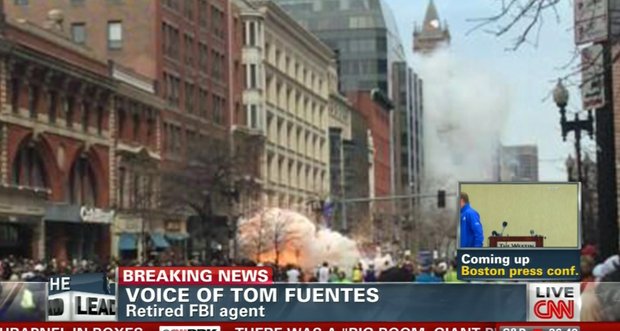
The bombing of the Boston Marathon Finish Line is delivered as spectacle violence

Over the past few days two events have been represented globally that are themselves symptomatic of the attention economy developing around us. The Attention Economy is ably defined by Wikipedia:
Attention economics is an approach to the management of information that treats human attention as a scarce commodity, and applies economic theory to solve various information management problems. In this perspective Thomas H. Davenport and J. C. Beck define the concept of attention as:
Attention is focused mental engagement on a particular item of information. Items come into our awareness, we attend to a particular item, and then we decide whether to act.(Davenport & Beck 2001, p. 20)
As content has grown increasingly abundant and immediately available, attention becomes the limiting factor in the consumption of information. Attention economics applies insights from other areas of economic theory to enable content consumers, producers, and intermediaries to better mediate and manage the flow of information in light of the scarcity of consumer attention.
The two events I refer to are

1. The Bombing of the 2013 Boston Marathon.

2. The Funeral of former British Prime Minister Margaret Thatcher.

Both of these events, while very different in terms of effects, are examples of what I see as a virulent attention economy which all of us are forced to participate in. The above two links are evidence of this, both leading to live news blogs updated by the minute from major media conglomerates.

What has disturbed me the most about the Boston Bombing, apart from more senseless bloodshed and suffering, is the total spectacle nature of this act of violence. Bombing the finish line of a mass sporting event (a considerable time after the 'main event' - i.e. the winner and so on - has actually finished) does little other than appropriates mediated spectatorship, turning it into a visualization of carnage, fear, panic and death. With no demands issued or responsibility taken thus far, this looks like a heinous attempt to spread fear and nothing else. Whoever is behind this violent act is using the spectacle offered by the marathon to spread fear and anguish.

Within the context of the attention economy we can see the Boston Bombing as an example of attention without a message. Central to this attention without a message is the flow-on effect of the mediated compulsory witness perspective. By 'witness perspective' I mean that the addressee is positioned by the media in a temporal and spatial perspective that is immediate and present in relation to the events depicted.

Even a cursory search online for accounts and explanation of the Boston bombing returns reconstructions, looped videos of the blasts, eye-level street views of the explosions and the scenes immediately afterwards and piece to camera from on-site witnesses. These images combined with live updates (often containing inaccurate information) and resulting in an uncritical sense of distance from the events. There is little commentary or reflection in live updates and streamed images.


Compared to the horrible events in Boston, the funeral of Margaret Thatcher is a more contentious spectacle. Here the mediation of history is being constructed through digital rhetoric and authority. An example of this contention is Prime Minister David Cameron urging the populace to participate in the perspective he supports by claiming "We are all Thatcherites now".


Many lining the streets for the Thatcher funeral cortege are expected to turn their backs on the hearse. This is an act of embodied resistance to the witness perspective as it is arranged according to authority. The above opening quote from Facebook, spoken by a woman intending to turn her back on the cortege is interesting in how the spectacle of the funeral is contrasted with Thatcher "getting a quiet family funeral". In the 'quiet family funeral' there are no witnesses outside the 'family'. The spectacle and subsequent demands made on attention are severely limited by this structure.

The implications of large scale events mediated in the ways described here for a global attention economy are dramatic and important. In the case of the Boston Bombing I feel ill at the thought of random acts of violence conducted in order to catch the attention of as many people as possible. In a grim prophetic comedy, this scenario reminds me of the bombings conducted in the Terry Gilliam film Brazil;

                         INTERVIEWER
                         Deputy minister, what do you believe 
                         is behind this recent increase in 
                         terrorist bombings?

                                     HELPMANN
                         Bad sportsmanship. A ruthless 
                         minority of people seems to have 
                         forgotten certain good old fashioned 
                         virtues. They just can't stand 
                         seeing the other fellow win. If 
                         these people would just play the 
                         game, instead of standing on the 
                         touch line heckling

                                     INTERVIEWER
                         In fact, killing people

                                     HELPMANN
                         In fact, killing people  they'd 
                         get a lot more out of life.

               We PULL AWAY from the shop to concentrate on the shoppers. 
               Helpmann's voice carries over the rest of the scene.
 
                         INTERVIEWER
                         Mr. Helpmann, what would you say 
                         to those critics who maintain that 
                         the Ministry Of Information has 
                         become too large and unwieldy... ?

                                     HELPMANN
                         David... in a free society 
                         information is the name of the 
                         game. You can't win the game if 
                         you're a man short.

The funeral of Margaret Thatcher stands as an attempt to establish a place in history for a political figure. As witnesses to the spectacle of her funeral people must adopt the position offered by an invisible 'Ministry of Information'.

"The Conservatives' attempt to enforce a national day of mourning for their former leader was announced so far in advance of the key event as to be macabre but at least half of the public aren't buying it" Laurie Penny, The New Statesman
By turning away from the funeral cortege the 'turners' (not a pun perhaps on the famous 'The lady's is not for turning' quote from Thatcher) bypass that perspective but they do not alter it. If we consider the insidious mis/use of the eye witness perspective which has already resulted from the Boston Bombing, perhaps it is all the more vital that alternatives are developed to the enforced temporal and spatial code of the mediated witness today. Whoever bombed Boston wants the kind of attention to the event that a funeral of an ex-Prime Minister is getting across the Atlantic today.

Wednesday, March 27, 2013

The Immersive Internet: Reflections on the Entangling of the Virtual with Society, Politics and the Economy


"The Immersive Internet provides the first omnibus account of the emerging world-view of people who spend most of their quality time mediated by computer-based technologies. It should be taken seriously by anyone trying to design a liberal arts curriculum for Humanity 2.0." – Steve Fuller, University of Warwick, UK

The Immersive Internet Reflections on the Entangling of the Virtual with Society, Politics and the Economy will be released by Palgrave Macmillan on Friday 29th March 2013. The internet has begun to develop into a much more immersive and multi-dimensional space. Three dimensional spaces and sites of interaction have not just gripped our attention but have begun to weave or be woven into the fabric of our professional and social lives. The Immersive Internet – including social media, augmented reality, virtual worlds, online games, 3D internet and beyond – is still nascent, but is moving towards a future where communications technologies and virtual spaces offer immersive experiences persuasive enough to blur the lines between the virtual and the physical. It is this emerging Immersive Internet that is the focus of this book of short thought pieces – postcards from the metaverse – by some of the leading thinkers in the field. The book questions what a more immersive and intimate internet might mean for society and for each of us.
Contents
1. Postcards from the Metaverse: An Introduction to the Immersive Internet; Dominic Power and Robin Teigland
2. Niggling Inequality: A Second Introduction to the Immersive Internet; Edward Castronova
3. The Distributed Self: Virtual Worlds and the Future of Human Identity; Richard Gilbert and Andrew Forney
4. Meta-dreaming: Entangling the Virtual and the Physical; Denise Doyle
5. Individually Social: Approaching the Merging of Virtual Worlds, the Semantic Web, and Social Networks; Francisco Gerardo Toledo Ramírez
6. Virtual Worlds as Radical Theater: Extending the Proscenium; Anthony M. Townsend and Brian E. Mennecke
7. Virtual Worlds and Indigenous Narratives; James Barrett
8. The Immersive Hand: Nonverbal Communication in Virtual Environments; Smiljana Antonijević
9. Discovering the 'I' in Avatar: Performance and Self-Therapy; Alicia B. Corts
10. Reflections and Projections: Enabling the Social Enterprise; Steve Mahaley, Chuck Hamilton and Tony O'Driscoll
11. Added Value of Teaching in a Virtual World; Inger-Marie Falgren Christensen, Andrew Marunchak and Cristina Stefanelli
12. Play & Fun Politics to Increase the Pervasiveness of Social Community: The Experience of Angels 4 Travellers; Maria Laura Toraldo, Gianluigi Mangia, Stefano Consiglio and Riccardo Mercurio
13. Framing Online Games Positively: Entertaining and Engagement through 'Mindful Loss' of Flow; Müberra Yüksel
14. Inhabitants of Virtual Worlds, Players of Online Games - Beware!; Antti Ainamo and Tuukka Tammi
15. Relationships, Community, and Networked Individuals; Rhonda McEwen and Barry Wellman
16. Gemeinschaft Identity in a Gesellschaft Metaverse; Cynthia Calongne, Peggy Sheehy and Andrew Stricker
Sorting out the Metaverse and How the Metaverse is Sorting Us Out; Isto Huvila
17. On the Shoulders of Giants: Understanding Internet-based Generative Platforms; Jonny Holmström
18. Social Norms, Regulatory Policies, and Virtual Behavior; Andrew Harrison, Brian E. Mennecke and William N. Dilla
19. Self-organising Virtuality; Rick Oller
20. Making Currency Personal: The Salutory Tale of the Downfall of the DomDrachma; Matthew Zook
Afterword; Tom Boellstorff

Saturday, February 16, 2013

Event Management in Real-Time Collaborations Across Mixed and Transmedia Realities


Presentation for AHRC Social Media Knowledge Exchange (SMKE) at University of Cambridge on "Managing Real-Time Event Collaborations Across Mixed and Transmedial Realities". This presentation is for the first of two workshops.

Two half-day workshops on using shared digital media for cultural and academic professionals

Social media is more than a Facebook account or a blog. Today there are many social media platforms that can be used as effective and inexpensive tools for event management and/or for participation and work in the knowledge economy. These two workshops, conducted by a social media professional with more than 10 years of international experience, will develop and share effective practices, experiences, tools and platforms on managing real-time events across a range of social media in professional contexts related to culture, arts and the humanities.

Workshop 1 – Event Management (20 February 2013, Wednesday, 9am – 12 noon, CRASSH)

1.     Identifying practical digital tools for using in event management – a list of 20
2.     The boundaries of space in mediating events; the virtual present and the presence virtual
3.     The ethics of crowd contributions, or, “Watch out, I am behind you!”
4.     Archiving the event; tagging, storing, streaming and collating
5.     Designing an event with digital infrastructure

Friday, February 01, 2013

Eric Schmidt: The Next 5 Billion - Life in Our New Connected Age


Eric Schmidt Executive Chairman of Google sketches out a future world in which cyberterrorists are targeted by government drone strikes, online identities are taken hostage and held for ransom, and parents explain online privacy to their children long before the subject of sex.

Eric Schmidt also said that his recent trip to North Korea had shown that the population there lives in an "utter information blackout" – but that change was certain to come, as well as for the 5 billion people worldwide not yet connected to the internet, for whom connectivity would bring enormous benefits and transform their lives.

Speaking to an audience at Cambridge University, in the first of a number of speeches outlining his view of the technological future, Schmidt said that he thought change would come "slowly and incrementally" to North Korea as the use of mobile phones spread, and with it information. Google has already updated its maps of the country since Schmidt's visit using "citizen mappers" inputting information to its Mapmaker software.

Thursday, May 03, 2012

The Internet of Things Mediated by QR Codes


A QR (Quick Response) code is two-dimensional visual structure that can be registered with a digital camera in a portable device. Whereas a linear bar code may accommodate 128 characters; a 2D QR Code, can comprise as many as 7,089 characters. QR code reader apps are available for the iPhone, the Android, and through service providers such as Sprint. QR codes can be scanned from even low-resolution computer screens, online videos (including YouTube), stickers and printed-paper. QR codes have been used to link to stored content not available on the Internet as well as lead the user to a specific website, special offer or otherwise unavailable multimedia content. Louis Vuitton has used QR codes in product design, and Teradadesign and Qosmo's N Building in Dubai allows users to read the building by accessing GIS-positioned Twitter entries from customers, make reservations and download coupons.


Qosmo's N Building in Dubai

The recent production by Cirque du Soleil of ‘Love’, a tribute to the music of The Beatles, features an iTunes app that is accompanied by a QR code for the 5th anniversary of the production. The user could unlock extra content within the app that includes music, video and still images of the show. The QR code also allows the user to enter a competition to win DVDs and music. Overall, the use of QR codes in publication and publicity has assisted in the expansion of multimedia and cross-platform content. The logical extension of the use of QR codes is as an added dimension to print publications, particularly in relation to subjects dealing with digital and multimedia production. In any use of QR codes there are three rules to observe:

1) Mobilize the landing page: the site the QR decodes to should be active and even live, with regular updates and a community aspect to it. If the QR Code you have made resolves to a url make sure the page is optimized for display on a mobile device. An easy way round this issue it to make sure the landing page is equipped with agent switching. If the site is not under your control then you can use Google’s mobilizer by adding the url to this string: http://www.google.com/gwt/n?u= If you are mobilizing your own site such as your blog then there is an even better option which will mobilize your site, generate a QR Code for the mobilized url and keep usage statistics, it’s called Delivr. Another possibility to consider is Mippin, which has an option to include advertising but you must have an RSS feed for it to work. Whatever you end up doing make sure the user of your QR Code sees content optimized for mobile devices because 99.9% of the time they will be using a camera phone.
2) The second rule of QR Codes is to make sure the url is as short as possible. Many mobile devices and reader software have difficulty with a QR Code matrix greater than 33×33 and some even falter with those dimensions. This means you should aim for a small matrix rather than a large matrix. In QR Code encoding the number of bytes at a given Error Correction Level (ECL) will determine the matrix size (see chart below) therefore a shorter url can mean a dimensionally smaller matrix. Dependence upon a third-party to decode and direct traffic is dangerous. The content, decoding and url/server provision should be handled by the publisher under contract or within the domain of the publication itself.
3) The third rule of QR Codes is, if the QR Code you have made resolves to a url, the online content must add tangible and significant value to any offline content. In terms of promotion added tangible and significant value includes prizes, limited access materials (special remixes or editions of recordings, limited edition T-shirts and so on) or discounts or coupons.
The method of delivery in relation to QR codes must be carefully considered. Malicious QR codes combined with a permissive reader can put a computer's contents and user's privacy at risk. Dependence upon a third-party to decode and direct traffic is dangerous. The content, decoding and url/server provision should be handled by the publisher under contract or within the domain of the publication itself. They are easily created and may be affixed over legitimate QR codes. On a smartphone, the reader's many permissions may allow use of the camera, full Internet access, read/write contact data, GPS, browser history, read/write local storage, and global system changes. Risks include linking to dangerous websites with browser exploits, enabling the microphone/camera/GPS and then streaming those feeds to a remote server, analysis of sensitive data (passwords, files, contacts, transactions), and sending email/SMS/IM messages or DDOS packets as part of a botnet, corrupting privacy settings, stealing identity, and even containing malicious logic themselves such as JavaScript, or a virus. These actions may occur in the background while the user only sees the reader opening a seemingly harmless webpage. Intricate, artist-created QR codes that are part of larger posters, or online in spcific websites are ways of lessening the risks for hacking with QR codes.

Sunday, April 29, 2012

Motherboard TV: Douglas Rushkoff in Real Life

For someone who likes to talk about the virtues of disconnecting, the media critic Douglas Rushkoff seems surprisingly always on. When I visited him at his storefront office near his home in Hastings on Hudson, New York, he was preparing to teach a new class, getting ready for a BBC interview, writing an essay, staring down a pile of articles to read, trying to figure out his new iPhone, and hurrying to finish his third book in three years – a graphic novel called ADD, which revolves around gaming culture, celebrity and the pharmaceutical industry. “It also asks the question,” he says, “what if attention deficit disorder weren’t a bug, but a feature?”

The hyper-speed hyperlinked life is familiar ground for Rushkoff, whose first book Cyberia, made him a popular tour guide to the Internet in the early 1990s, and an early prognosticator of its radical potential. But much has changed between the awkward days of “the ’Net” – then a non-commercial collection of public networks, accessed by local ISPs – and the overloaded era of Facebook, YouTube and iPhones. If Rushkoff is well versed in the language underneath the “digital revolution,” he’s also become one of its most outspoken critics.

“A society that looked at the Internet as a path toward highly articulated connections and new methods of creating meaning is instead finding itself disconnected, denied deep thinking, and drained of enduring values,” Rushkoff writes in 2010’s Program or Be Programmed. His remedy is simple, if ambitious: once people begin to understand how software works, “they start to recognize the programs at play everywhere else – from the economy and education to politics and government…All systems have embedded purposes. The less we recognize them, the more we mistake them for given circumstances."

Understanding how things work In order to make them work better is the basic hacker ethos, but Rushkoff has applied it to his broader discussion of the way the culture and politics of the many are driven by the interests of the few. Between his landmark Frontline documentary The Merchants of Cool to his recent book Life Inc., Rushkoff has indexed the risks that capitalism and corporate influence pose to democratic society. Or, to extend the metaphor, he’s sought to show how we the users routinely get screwed by an “operating system” that’s over 500 years old.

“We’re leveraged in so many ways, it’s like, our economy is leveraged to produce more than it can in order for it to survive,” he says. “It’s leveraged to grow. Human beings are financially leveraged now. So how do you roll that back and say, well, you know, ‘this is it’?” Or, rather, “How do you get the good of a zombie apocalypse without the zombies? That’s sort of what I’m trying to help people with.”

Enter Occupy. Rushkoff has watched the movement with cautious optimism, penning editorials on CNN and organizing November’s Contact Con, a powwow of net roots activists and open source hackers working to foster new civic-minded apps and hardware. To include prizes, Rushkoff enlisted the help of Pepsi, which ultimately granted $10,000 to the Free Network Foundation, which was profiled in our recent documentary.

Rather than shun corporate sponsors, Rushkoff revels in what they bring to the table, and in the contradictions of the movement. Occupy’s power, ultimately, is its meme — the idea that a citizenry can not only protest the system but demonstrate a new way of responding to it and reworking it. Like his call to program, Occupy’s nebulous mission may be hard to swallow or carry out. But that also lends it its own kind of power, he says. Its radical promise isn’t unlike the earlier Internet’s: a distributed and open system that could change civic discourse and remake culture.
But as on the strange battlefield of the Internet, Occupy could also crash against its own giant ambitions, which will be heavily tested in the next few months, starting with next week’s “general strike”. Progress will have to be made gradually, says Rushkoff. “There are ways to slowly move towards a sustainable life path, and it’s just a matter of doing that, and I’m hoping that more people in Occupy start seeing it that way – in that more subtle way, rather than exclusively in the kind of activist, let’s-get-pepper-sprayed by cops way.”

Much has changed in the decades since Rushkoff started critiquing the system. But his philosophy is still animated by a big question, one that applies not only to the digital spaces of the Internet, built by the Facebooks and the Googles, but to other kinds of “public” spaces too, in town squares, Congress, and culture: who programmed these spaces, and to what ends, and how can they be hacked into something better?

Friday, January 27, 2012

The Textual Internet

Key quotations used in a lesson for Language Consultancy Program in HUMlab yesterday. The full notes for the class are here.

Tuesday, January 24, 2012

My Online Profile

Monday, October 10, 2011

Blogging the (Un)Control Machine


“I broke out my camera gun and rushed the temple — This weapon takes and vibrates image to radio static — You see the priests were nothing but word and image, an old film rolling on and on with dead actors — Priests and temple guards went up in silver smoke as I blasted my way into the control room and burned the codices — Earthquake tremors under my feet I got out of there fast, blocks of limestone raining all around me — A great weight fell from the sky, winds of the earth whipping palm trees to the ground — Tidal waves rolled over the Mayan control calendar.” - William S. Burroughs, “The Mayan Caper”.


The author William S. Burroughs proclaimed, “smash the control images, smash the control machine” in “The Mayan Caper” from his 1961 novel The Soft Machine. Burroughs believed that the word and image has been used throughout human history to control thought. He particularly associated it with the Mayan civilization of Meso-America. Whether or not Burroughs was historically correct in his assessment of the “Mayan control calendar” is largely irrelevant today, if one pays attention to Burroughs more simple claim that images and words populate the imaginations of people when they are broadcast using the electronic mass media. Mass media for the majority of Burroughs’s life (1914-1997) was broadcast using the one-to-many model. Newspapers, Television and Radio beamed messages into the lives and minds of millions of people every day. This network of one-way information channels (if one ignores the heavily censored Letters to the Editor and talk back radio) is drowning today in an ocean of user driven digital content. Fourteen years after the death of Burroughs, anyone who can access the Internet can fashion their own ‘camera gun’ and begin beaming images into the minds of others. As a revolutionary force, the writings of William S Burroughs provide us with a set of principles that can be used to understand how the ruling order is replaced in relation to the digital media sphere. The blogs, wikis, live feeds, podcasts, web journals, micro blogs, RSS feeds and forums of today are soft weapons that ‘take and vibrate images to radio static’, breaking them up, distributing them and making the digital food of revolution. Blogging with its millions of channels is now the media ‘uncontrol machine’.  
In his fiction Burroughs paints a picture of a bygone society where one delves “Into the interior: a vast subdivision, antennae of television to the meaningless sky. In lifeproof houses they hover over the young, sop up a little of what they shut out” (Naked Lunch 11). Today it is nearly impossible to shut much out in the average suburban Western home, and controlling production of media content is like trying to contain a solar storm. Millions of channels circle the planet offering input and output possibilities for anyone with a story or an image. Among the many, the Chinese government attempts censorship in the face of this image horde, but there are always holes in any Great Wall. Recently a colleague travelled to China to give a series of lectures on film and the digital image. She was of course unable to access YouTube, so she Skyped instructions about which videos to rip off the site and I sent them to her from Europe via the file-sharing site Sprend. These videos were then shown in a Chinese university lecture hall. This is just one crude example of how information always finds a way. I would like to mention some others.
The proposed revolution of the Occupy Wall Street (OWS) movement is radio-sonic, if one judges by the radiating ‘i’ logo of the Global Revolution livestream site.  Twenty-four hours a day, beginning on September 17th 2011, people began occupying Zuccotti Park (Liberty Park) in Downtown Manhattan in New York. Coinciding with the physical occupation is the digital barrage of Twitter (micro-blogging run off hashtags), the live video stream, forum discussion, archives of links and comments, blog posts, still images, podcasts, live audio streams, email lists and YouTube videos. This river of information has sparked Occupy [enter-town-name] around the USA and even overseas. What could be relegated as a collection of disenfranchised and left-leaning complainers has quickly evolved into an idea (“occupy everything” seems to be its slogan, and it of course comes with a manifesto http://occupywallst.org/article/a-message-from-occupied-wall-street-day-five/). The ability of digital media to spread this idea (and I am doing it right here) is a testament to the tenacity of the word virus. The need to overcome the dominant dream narratives is most recently articulated by popular Slovenian philosopher Slovoj Zizek when he spoke at OWS on 9th October 2011 and said, "The ruling history has even limited our capacity to dream". The dream of authenticity goes on.


Philosopher-at-Large Slavoj Zizek addresses the crowd gathered in Liberty Plaza


Global Revolution media feed, Saturday October 8th 2011. The end of the Mayan Calendar as we know it?

The OWS movement is the latest and possibly most visible outside mainstream media of a series of high profile digital image barrages connected to popular protest and resistance we have seen develop over the last couple of years. In a rough time line that also shows a growing sophistication, these include the 2008-2009 Israeli-Gaza War, the 2009 election protests in Iran, the revolutions in Tunisia, Egypt and Libya, the civil uprising in Syria, and finally the present Occupation of Wall Street. The Israeli-Gaza War was mostly conducted on the Internet via Twitter, with some videos and websites taking up the events only often after they occurred. The 2009 election protests in Iran were Twitter based, but many of the feeds from the micro blogging site were located outside the boarders of the Islamic Republic. However, videos built an enormous following online for the ideas and demands of the dissident forces in Iran. This culminated in the murder online of Neda Agha-Soltan, a video of the shooting death of a beautiful young woman on a street in Tehran that went viral. As Neda gazed into the camera lens, blood gushing from her nose and mouth, the viewer was propelled into the human drama of a cruel and unjust situation. The image wars in Iran had just been stepped up a notch.
The speed of the revolution in Tunisia stunned the world. On 17th December 2010 a street vendor in the town of Sidi Bouzid set himself alight in protest over long term persecution by corrupt local street officials. Mohamed Bouazizi died on 4 January 2011, at 5:30 pm local time. Protests began immediately afterwards, and built up until President Zine El Abidine Ben Ali fled Tunisia with his family on 14 January 2011. The rest is history, and the role of social media in the build up to the flight of Ben Ali is contentious. Wikileaks is said to have playeda significant role in the turn of events in Tunisia, along with high unemployment, inflation and official corruption. However, the Tunisian uprising is clearly an example of the masses no longer believing the official control narrative of the government. As Mohamed Bouazizi lay dying in his hospital bed, Ben Ali visited him on December 28th 2010, promising to appoint a new Minister of Youth and to look into the unemployment problem (running at around 40% in Sidi Bouzid) . What resulted from the visit was an undermining of the official information line, with Al Jazeera reporting, “For many observers, the official photo of the president looking down on the bandaged young man had a different symbolism from what Ben Ali had probably intended.” The game was over for Ben Ali and a new set of images are still being developed to replace the old in Tunisia.
The revolutions in Egypt and Libya seem to follow a similar pattern to that of Tunisia, as information channels are gradually developed and become dominant, in form if not in content. This progression often mirrors the changes occurring in the streets and corridors of power in each nation. Images replace images as power shifts. Flows of information supporting one group or idea become larger, more regular and more widely distributed, as support grows and gains are made on the ground. What is different from the usual flows of propaganda in any political changeover is that the sources in these contemporary changeovers are multiple based on weight of numbers. While major broadcasters such as Al Jazeera covered the assembly in Tahrir Square in Cairo from atop the buildings around it, creating a visual metaphor of distance and collectivity, the real coverage was happening on Twitter, YouTube, Facebook and countless Egyptian blogs. Wael Abbas, Sandmonkey, Hossam Eid, Ali Seif, Nora Younis, Misr Digital, and Baheyya are some of the most popular blogs. It must also be remembered that in the last weeks of the regime of Hosni Mubarak the Internet was shut down for the entire of Egypt in an attempt to silence dissenting images and ideas. Microsoft billionaire Bill Gates commented on the shut down in a highly perceptive analysis, "Whenever you do something extraordinary like that, you're sort of showing people you're afraid of the truth getting out." In the same story by The Huffington Post it was revealed that efforts to shut down such an information network inevitably fail. As they did for Hosni Mubarak.
Attempts are still made in digital media sites to summarize the movement in a single form of language. In doing so the summary attempts to return a movement to the singular, what the Russian philosopher Mikhail Bakhtin calls a monoglossia, which identifies the locus of control with the authoritative interpretation of the word. The OWS movement is one example of this, where a major digital news site took pictures of 34 people in Liberty Park and described it, as “This should give you a pretty good idea of the different types of people occupying Wall Street“ .  What I would ask of buzzfeed’s summary of who is occupying Wall Street is where does the occupation begin and end? Is the video feed running 24 hours a day part of the occupation? What about the forums, blog posts, videos, and Tweets? Are they part of the occupation? If they are, where are they? With millions of channels open all over the Internet, the occupation of Wall Street has become part of the infrastructure of the World Wide Web, which as its name suggests, is worldwide. There is no place for an idea, as it occupies the world as a virus does, in time but not in space.
As the forms and practices of the OWS movement become more established they are copied. Well not so much copied, as manifested. It is contagious and how it is going to end we do not know yet. In researching this article I cam across a new site in the United Kingdom called BEYONDCLICKTAVISM, which gives a little bit of background and then four reasons for its existence:

Beyond Clicktivism was set up following the netroots uk event primarily to address the following questions:

  • What can we do online that is uniquely progressive so that if others emulate us their response is informed by progressive values?
  • How do we get people climbing the ladder of engagement, moving from Facebook “Likes” to actual concrete action?
  • How do we integrate progressive use of social media with non-political use of social media?
  • How can we build tools that can also be used to call politicians to account and stop the next Blair or Clegg from flying in the face of the principles of their parties and shamelessly tearing up their pledges to the electorate?

Directly below these points is the statement; “The scope and ambitions of the site have expanded since then.” I am sure I can say the same thing about the activists and media artists mentioned in this text, working around the clock and around the globe to realize some crazy dream they have, over and over again.

Saturday, September 24, 2011

Why and How I am Leaving Facebook

My Facebook Page 24th September 2011

I have been a Facebook user since August 2007, when I began investigating it as a real time social text. Four years later I have so had enough. The upcoming changes in the form of Timeline is not the same program I signed up for in 2007.  


When I signed on to Facebook in 2007 it was defined as "a social utility that connects people with friends and others who work, study and live around them." Now, with the implementation of Timeline, Facebook is defined by its founder as “[A]ll your stories, all your apps, a new way to express who you are.” Anyone familiar with the architecture of Facebook knows that it is far from simply 'expressing who you are' on the platform. Who I am on FB is formed by Facebook itself. If I contribute 'all my stories, all my apps and express myself' on FB, I see myself as losing those contributions to the vast database of the program. Plus with Timeline I am now part of an information flow in real time, the nature and perimeters of which I do not control. Suddenly friends-of-friends are within my feed and I am, I presume, within theirs. There is little time or space available for my own self-expression in FB now, because if I even just throw a pebble in the pool, it returns to me as a Tsunami of unknown origins. The entire equation of FB has changed. the analogy used by the Napperville Sun is today ancient history:

"To users, Facebook will no longer be a bench by the side of a river where they sit and watch an endless flow of ephemera float by and then disappear."

I prefer the village square or Agora analogy myself, where I once could go to share with a group of people whom I actually knew, and we could talk, share links and catch up. The circle I once had on Facebook seems to be possible today with Google+, or at least that is what I am hoping.

Added to the expanse of contacts and information I am exposed to on the 'new Facebook' is the somewhat sinister promise of the Timeline interface, which is described by one commentator as,
"Your Facebook presence is now intended to be durable. In 2029, when your firstborn son’s holographic avatar is going off to lunar robot fighting school, you can rewind your Timeline to 2011 and show him what you were up to in the week before he was born."
as well
"Facebook's updated Open Graph will make the social network far more "sticky." Zuckerberg said users will have the ability--thanks to Timeline and a new addition, Ticker--to see what a friend is doing, like watching a movie on Netflix or listening to a song on Spotify, and engage in that same activity from within the social network. The Facebook CEO said he believes the improvements will help create "a completely new class of social apps" that will let users share every single facet of their lives on the social network." - (Cnet) Facebook Changes Creeping Out Some Customers

To me this sounds like a total nightmare scenario.The week before my son was born was and are my memories, my images and mine to explain to him should I choose to do so. Facebook or any other web platform (that I do not control) has no place in the representation or explanation of that period in my life. Futuristic fantasies do not convince me otherwise. Added to this is the intrusion of Facebook cookies;

"Even if you are logged out, Facebook still knows and can track every page you visit. The only solution is to delete every Facebook cookie in your browser, or to use a separate browser for Facebook interactions." - Logging out of Facebook is Not Enough


However, I have a real problem in that the contacts I have gathered in my four years of using Facebook represent a large percentage of the entire number of people I actually know. I have real people in Facebook; friends and family. People I do not see, that are scattered around the globe. Many of them are very important to me. So I am busy exporting as much of the information in my account as I can. First the email address of my friends, all 397 of them:


Go to address.yahoo.com and click the Facebook icon. A log-in dialog should pop-up, just sign-in with your Facebook credentials and within seconds, you entire Facebook address book will be available inside your Yahoo Mail Account. Once the import is done, click this link to download a CSV file with the email addresses of all your Facebook contacts to your desktop. You can then import the CSV file into Gmail Contacts, LinkedIn, your phone address book or any of the social sites where you want to connect with your existing Facebook circle. If Yahoo! is unable to import your Facebook Address book, open your Facebook page and choose “Application Settings” under Account. Next remove the “Yahoo! Contact Importer” application from your Facebook profile and try the steps mentioned in the video again.

I have a Yahoo mail account so this was easy. I now have all my FB friends in my Gmail account. I now have to find those of my FB friends who are on Google+ via their email addresses. This is time consuming but not impossible.

You’ll find instructions to download the data in your Account Settings page. Once you’ve logged into your Facebook account click Account and then choose Account Settings from the drop-down menu.


On the first page of settings (cleverly titled Settings) you should notice a new option beneath Language that says Download a Copy. Click on it to lodge your request.


I did not receive an email notification that I could download a copy of my account and I had to log back in to Facebook and click on Download a Copy again where I got this message:


Another way to export the data related to your friends on Facebook is with the Facebook Friend Exporter plug-in for Google Chrome


Facebook has been doing everything it can to prevent the Chrome plug-in from working and I did not have much luck with it. However other people say it works and the advantage of it is that it exports not only emails, but phone numbers and photos as well.

To download any of your Facebook photo albums with ease, all you need is Fotobounce - it's a free Windows-only utility that would help you manage photos in your Facebook and Flickr accounts right from the desktop.

The links and collections of videos, audio and comments I have collected on Facebook seem to be doomed to oblivion. FBexport is one of many programs that functions as a web scraper, and it claims to be able to extract the following:

 
Using a web scraper to retrieve you data from Facebook will get your account closed permanently as it breaks the terms of use agreement. Section 3.2 states the following:
You will not collect users’ content or information, or otherwise access Facebook, using automated means (such as harvesting bots, robots, spiders, or scrapers) without our permission.
The problem with having your account closed and not deleted, as is the aim if you wish to discontinue your relationship with the Zuckerberg Empire, is that a closed account is still in existence and the contents of it remain the property of Facebook. This is a tricky situation. But if you are deleting your account anyway this may be a stylish way to go out. Just make sure you know when you want to be banished from the land of Facebook and understand that everything in your account still exists on the servers of Facebook. I hope to be exiled by the end of next week but I will not be leaving anything behind when I go.

Finally since publishing this post yesterday I have been getting a lot of traffic from Facebook itself. In directing the link here FB publishes the following warning:

The propagation of fear is the last resort of the wicked. Censorship is built into the architecture of Facebook and this is another reason why I am closing my account.

To delete the Facebook account follow the link here and then the instructions.