This is an essay I completed last week for my Postmodernism Postcolonialism course work unit. I have now finished the majority of my course work so this is good. Although this is a bit long, I wanted to put it here as I enjoyed writing it and also the days I spent reading and thinking about T.S Eliot, Vivian Eliot and Ezra Pound were profound indeed.
 The Waste Land: Collage, Hypertext and the Nodes of Meaning.
The Waste Land
The Waste Land: Collage, Hypertext and the Nodes of Meaning.
The Waste Land is a collaborative work created by
T.S. Eliot who wrote the text/s,
Vivien Eliot who both wrote and edited and
Ezra Pound who edited and collated the various manuscripts together to create the poem first published in 1922, the same year as James Joyce’s
Ulysses. The text itself is comprised of a variety of language discourses ranging from interiorized monologue and intimate daily speech to elegy, mythology and a World War One marching song. These are collaged together around themes related to mortality and the possibilities of death/life in/after life/death. In this essay I wish to explore the issues surrounding the dispersive prose narrative of The Waste Land in regard to Pound’s concept of language nodes or “the Vortex”. In reference to this I construct here a metonymic reading of The Waste Land and conclude in the relevance of such a reading to the recent adaptation of the original authoritative text as an online hypertext publication of the work. In this discussion I do not intend to detract from T.S Eliot’s designation as author but rather to examine the space between the original text, its primary editor Ezra Pound, and the philosophies of literary production that may have influenced its production and the course it set in English literature over the proceeding years. Its continued relevance today is furthermore embodied in its place as a hypertext on the World Wide Web.
Pound’s Vorticist theory of writing is the basis for this essay as a metonymic reading.
In Gaudier-Brezeska (1916) Pound wrote:
The image is not an idea. It is a radiant node or cluster; it is what I can and must perforce, call a VORTEX, from which and through which, and into which, ideas are constantly rushing. In decency one can only call it a VORTEX. And from this necessity came the name “voritcism”.” (Perloff 1981:160)
The relationship between the form and the idea being fluid and flowing is consistent with metonymy as a blended space of meanings. The metonymic sequences of
The Waste Land produce a profound and often individual understanding for each reader. Separately each of the five parts of text could be construed as having very different meanings to that of the whole, as would each of the shorter single image poems discussed below. Combined they provided a deeply immersive poetic experience and in its entire form it has come over time to symbolise a malleable discourse around twentieth century western culture.
In understanding Pounds concept of “radiant node or cluster” the importance of his long study of the
Chinese language should be acknowledged. In 1908 Ezra Pound benefited from the estate of
Ernest Fenollosa when he received the orientalist's very large collection of unpublished scholarly papers. He had already developed a strong interest in both Chinese and Japanese literatures and was translating Chinese as early as
1903. His use of what he understood to be
Chinese characters as ideograms emerged out of his imagist period (1912-14) as exemplified in the famous poem
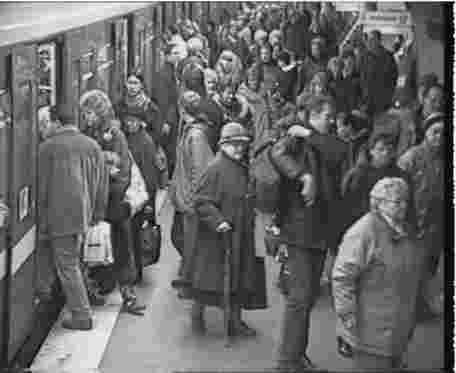
In a Station of the Metro(1916):

With this in mind The Waste Land may be read as a constructed series of “one image poems” that combine in a metonymic structure to provide the potentially great number of cohesive readings which can be applied to it.
There is not a sequential development of narrative/s in
The Waste Land, rather it presents a flow of images and exchanges that seem to hang together by the thread or “dried tuber” root of their origins. This is accomplished through an extensive system of reference and appropriation of historical, mythological, religious and literary sources and to the structural collage technique initiated by the Eliots and finished by Pound. The reader is met with a cascade of vegetative, corporeal, and urban imagery that all seem to exist outside time in a permanent state of decay and death but never climaxing in total dissolution, merely the suspended animation of the desert, watery preservation or the living dead. Each of the five parts in turn progresses analogically from a biblical ‘man drawn from the soil’ and childhood thematic (interiorized, thought base, nervous) to ‘alienated urban individual’ (language, self, sense perception) to the ‘profane world minus the creator.’ (city, nature, society). These themes are developed in relation to each other spatially and result in the metonymic meaning so characteristic of the work.
The 1925 second edition of
The Waste Land is dedicated to its co-creator/editor Ezra Pound as “il miglior fabbro”; the better craftsman. Pound was a founding member of the Vorticist movement in 1914 adapting and redefining its art driven, proto-fascist principles to the realm of literature, and particularly poetry. In 1921 and 1922 Pound made major changes to the text in editing
The Waste Land, the most dramatic example being
Part IV Death by Water which he edited down from over 80 lines to just 10. It would be unlikely that the “craft” Pound applied to the text was not deeply influenced by his own philosophy regarding language and in particular his Imagist-Vorticist ideas. The concept of “radiant node or cluster” applies well to
The Waste Land when we consider a metonymic reading of the work. As a compositional text in terms of authors, technique and themes no single line of procedural or sequential narrative can be established though the 435 line poem. Rather small particles (often just two lines) of text are the independent nodes which combine to build up the greater poetic. In these there are clear compact moments of distinct imagery which combine to give the poem its overall atmosphere or one could even say meaning/s. Such powerful nodes as “That corpse you plated last year in your garden, / Has it begun to sprout? Will it bloom this year?” (71-72) provide points upon which the reader’s attention hangs as they negotiate their path through the topography of
The Waste Land. From such a feature on the landscape the reading can transverse out through networks of meaning centred upon such themes as death and vegetative interconnectedness. From the vegetative node there is a connection to the dual theme centred on water (drought/flood) and the further associations with life and death.
To begin identifying themes in
The Waste Land it is memory projected as narrated direct speech which opens the poem. The famous seasonal opening, “April is the cruellest month, breeding “ (1) is followed by recollections of a group (perhaps a family) in a holiday-like atmosphere “coming over the Starnbergersee” (8), taking coffee in the Hofgarten (10). From here it returns again to the opening lines powerful organic imagery of plants, rocks and water. Magic is then taken up within this theme through both plant and rock; “Here is Belladonna, The Lady of the Rocks,” (49), and the presence of Madame Sosostris provides it with a material system; the Tarot. The city is also introduced here as the “Unreal city” (60), another form of a material system, and presents as a recounting of a nightmare vision from Dante’s Inferno: “A crowd flowed over London Bridge, so many / I had not thought death had undone so many” (62-63). This city is operating under the system of time, as embodied by the
Saint Mary Woolnoth clock. Time is constructed as a system that can only be avoided by death, “With a dead sound on the final stoke of nine.” (68). From this a further relation is constructed with both history and memory containing the sprouts of death; “That corpse you planted last year in your garden, / Has it begun to sprout? Will it bloom this year?” (71-72). This development of the vegetative theme in conjuncture with the temporal propels the reader from the manifestations of human recollection (time, history) into the nature of being human, that is hope, memory and death.
The trope of ‘System’ runs into the title of the second part of the poem, The Game of Chess, but in Part II the players are also the narrators or authors of the game as much of it is direct quotes from speaking subjects. One of the primary themes in The Game of Chess is the orientation of an inside/outside binary as arranged around the self. Here the domestic emerges from a mythological theme based around
Ovid’s Metamorphosis; “The change of Philomel, by the barbarous king” (99), along “withered stumps of time” (104). The narration moves from mythological change and duality to two contempory urban people in a room “in rats’ alley” (115). The context or origin of these lines is understood to be speech recorded as prose from conversations between Tom Eliot and his wife
Vivien, “My nerves are bad to-night. Yes, bad. Stay with me.” (111).It could be either one of them speaking but their combined attention progresses outwards from thought (interior, thinking), to noise (sense, intermediate, speaking) to natural phenomenon; “what is the wind doing?” (119) to society; “walk the street with my hair down, so.” (132-133). From this taxonomy of perception the direct speech of the two goes on to become the speech of many. The climax of this collaged progression provides a spatial context not stated directly in the work; a public house and the gossip of drinkers bringing the world of their troubles and sorrows from outside to within, the recognized location of such a statement as “HURRY UP PLEASE ITS TIME” (165). The same time that governs by Death at the clock of Saint Mary Woolnoth also governs the recounting and gossip of the tavern. As night falls the public house empties out into the street and Part III comes;
The Fire Sermon and here it is the city that contains all, both the dead and the living. Whereas Joyce’s
Ulysses is founded heavily on an allegory of pre-Christian mythology, Eliot’s city (a narrated London) is the topography for an early Christian grail quest. A prayer ends Part III and
Death by Water embodies further reference to classical themes in what became under the Eliot-Pound production process the heavily edited Part IV.
Comprised of only 10 lines Part IV is the turning point of the poem.
Death by Water takes the form of a brief elegy for
Phlebas the Phoenician (Phlebos Gr: “vein”) which recollects the fictitious tarot card of “the drowned Phoenician Sailor” (47) of Part I. The implied binary between blood and water is clear in Part IV, although the binaries actually written of here are “profit and loss” (314), “rose and fell” (316), “age and youth” (317), “Gentile and Jew” (319). The future is invoked in the elegiac form by reference to the dead as “O you who turn the wheel and look to windward, /Consider Phlebas, who was once handsome and tall as you.”(320-321). This direct address to the reader places the intention of future (“look to windward” implying both the -future- direction to be sailed toward and lush rain –life- receiving side of an archipelago) as a challenge, or as a question. It is as if we are the still living by the grave side and the consideration is to be ours. This oral theme returns us to the opening of The Waste Land where memories are invoked and the events of a life are recounted in hindsight. This circular closure achieved through the return to the opening theme of recollection and memory brings us to the final Part V of the poem,
What the Thunder Said.
The theme of the final section of the poem is a metaphysical cosmology based upon principles of a divine presence or absence in the world. Future and history seem to have crumbled by the time the reader comes to Part V; “He who was living is now dead / We who were living are now dying / With a little patience” (328-330). Destruction as manifest in the afflictions of time (decay, drought, age) rages across the material world which alternates between bone dry desert and flood. Hindu and Christian imagery intertwine around the ruins of the great cities and human perception is constructed as the prison in which we all sit, “We think of the key, each in his prison / Thinking of the key, each confirms a prison” (414-415). In a clear reflexive moment the poets own voice appears in the fourth last line to claim that by “These fragments I have shorn against my ruins” (431) but this in turn is cast aside with a twist for in the final line the only truth seems to stand as
"Shantih shantih shantih" (435), Sanskrit which translate roughly as "The Peace that passeth all understanding", even presumable the understanding of poetry. In this the narration steps outside itself for a final abysmal moment of clarification and folds in upon itself like a vortex.
'Flow’ or ‘Direction’ as a theme can be read in “A crowd flowed over
London Bridge, so many / I had not thought death had undone so many” (62-63). The great movement towards death which the narrative voice seems struggling to be to be outside of as in such couplets as “There I saw one I knew and cried “Stetson! / You who were with me at the ships at Mylae!” (69-70) are part of this flow or directional theme. In Part II
The Game of Chess the flow of images continues along a movement from day to night, from inside to outside, from thought to sense perception in the dialogue of the speakers and in the movement from the private house to the public house and then into the street. This movement is maintained in Part III
The Fire Sermon in the pathways of the city taken by the wandering witness and in more intimate exchanges such as “Bestows one final patronising kiss, / And gropes his way finding the stairs unlit” (247-248). Again here is a leaving into the night, the flow from the sensual body into the loneliness of a darkness that is imagined as death-like. In Part IV we meet death directly in the elegy of Phlebas the Phoenician and the circle between inside and outside, day and night, thought and thing is near to closing. The Zen koan-like couplet: “We think of the key, each in his prison / Thinking of the key, each confirms a prison” (414-415) brings the dream vision of the poet to an end. Uniting the image with the thing in the thought of it and with this juncture is the realization that the poet too is in the crowd shuffling across London Bridge towards death. The poem offered as “fragments …shorn against…ruins” (431) are ruins in themselves and the flow of life to death, as in the flow from day to night, cannot be avoided or even negotiated with through such vehicles as poetry.
The adaptation of a text from one medium to another can, in a type of radical textual intervention, expose elements of the text at its most basic levels. During his life T. S. Eliot made an influential audio recording of The Waste Land (1946) in what
Virginia Woolf described as his "sepulchral voice". In 1968 the original manuscript was rediscovered and published with the editing process coming under closer scrutiny, revealing among other things the role of Vivien Eliot (d.1947) in the production process. Recently
The Waste Land has been adapted as an online hypertext and the metonymic structure of the poem is brought to the fore through a text that can be read in many directions due to clickable links and multiple revisions upon Eliot’s original notes. In the hypertext adaptation of The Waste Land the nodes as metonymy are transformed as portals which lead to parallel readings of the “one image poems” comprising the greater work. As well as this the exterior or contextual sources that were once necessary to understand the many historical, literary and classical references in the text (outside the footnotes and introductions of critical editions) are interwoven into the hypertext adaptation.
There are several hypertext versions of The Waste Land on the internet but in terms of metonymy the edition found at
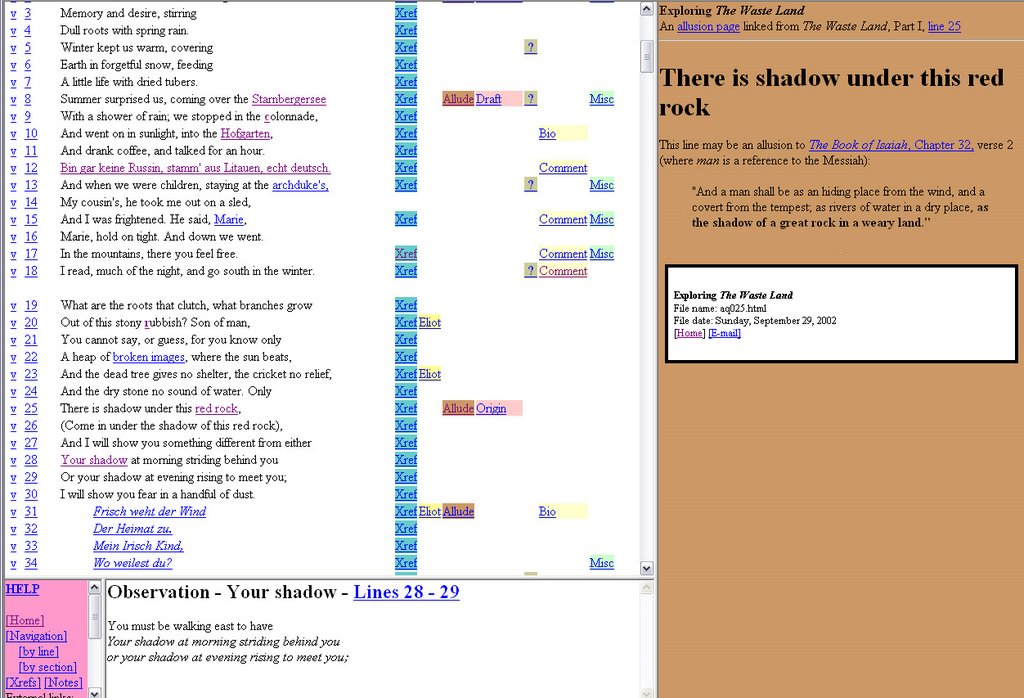
http://world.std.com/~raparker/exploring/thewasteland/explore.html is more applicable due to its strong sense of contextual references and more extensive and maintained links. In this adaptation the 435 lines of the original poem have been transformed into thousands of lines, including linked books of the bible (also as audio), the Aeneid of Virgil, images of the church of St Mary Woolnoth, the works of other poets (Chaucer, Whitman, Baudelaire) and the personal sources for Eliot for the imagery of the poem. In a metonymic fashion one linked word or phrase leads to larger networks of information and associations. The below screenshot provides an example of how three windows of text can be run simultaneously both in reading the original text as well as the metatext provided from internal hypertext links:

The main white coloured window is the text of the original poem, with links on phrases or words in the text as well as commentary (yellow), Allusions (brown), Draft material (pink) Cross references (“Xref” in blue), Eliots notes (“Eliot” in yellow), exercises for students (“?” in olive), and Miscellaneous (“Misc.” in turquoise). The brown window to the right hand side of the screen displays material from choices made in the colour coded links in the main window and the smaller window at the bottom of the page is for links chosen from within the actual body of the poem. The small pink window in the bottom left hand corner of the screen brings in choices from outside The Waste Land, such as help with the document set-up and information about the site’s creators.
To outline a reading strategy for the hypertext The Waste Land I will follow a single line of metonymic association from line 60 of the original text; “Unreal City”. According to the cross reference link there are multiple cross references for both the words ‘Unreal’ and ‘City’ in the original text of The Waste Land. The word ‘Unreal’ is repeated three times in the text, twice in conjunction with ‘City’. The word ‘City’ occurs in seven other contexts in the poem and is found twice in line 259. Eliot’s own note draws the association with
Charles Baudelaire's poem Les Sept Viellards (The Seven Old Men), in particularly the lines; “Fourmillante cité, cité pleine de rêves, Où le spectre en plein jour raccroche le passant.” A translation is also provided in the hypertext adaptation; “Swarming city, city full of dreams / Where the spector in full daylight accosts the passerby.” There is also a link which opens in the same window to the original Baudelaire poem in both French and English. The “Allude” link provides the same information about the Baudelaire association. From the Poetry hyperlink in the text a window opens to where some present day aspiring Ezra Pound has re-edited the punctuation because “I was personally having a small problem following Eliot's thoughts on lines 60-68 because of the interjection of the narrator's thoughts on death's undoing of so many into the description of the flowing crowd”. (Exploring The Waste Land File: pq060.html September 29, 2002). Within this shadowy editorial voice there is present an echo of the formation of the original text over the dividing 80 years.
Although the newly integrated content of the hypertext adaptation is in many ways somewhat simplistic and quantifiable, the relationship to the method of metonymic reading, collage, ideograms and the Vortex is coherent. A hypertext adaptation could be made of any poem, but the nature of The Waste Land encourages a genealogical development from the 2002 hypertext adaptation of the text to the original published poem of 1922. The poem’s thematic system of discourse and its metonymic nodal structure in turn encourages re-readings and re-interpretations. The Waste Land today is a historically important text, developed collaboratively; it is dispersed in the sense of both language discourses (speech, elegy, mythology, song) and production (the Eliots, Pound) as being a collage. “The Waste Land” of today has come down to us as a cultural and literary node developing from early Vorticist and imagist philosophies to the hypertext of 2002.