We are at war, yes, but this is not an economic war. It is a world war
against the economy. Against the economy that for thousands of years has
been based on the exploitation of nature and man. And against a
patched-up capitalism that will try to save its skin by investing in
natural power and making us pay the high price for that which—once the
new means of production are created—will be free as the wind, the sun,
and the energy of plants and soil. If we do not exit economic reality
and create a human reality in its place, we will once again allow market
barbarism to live on. - Raoul Vaneigem (2009)
The War we live in is waged via virtual and violent means. People are dying in Syria as they are supported by the digital infrastructure provided by the Telecomix network. People are going to jail in Europe and North America, and dying in the process for what they believe should be the future for humanity. Massive cyber-attacks are probably happening right now on large institutions of power in the powerful nations of the world. The United States government is using drone devices, an extremely high level technology, to kill its own citizens. This is a war with technology and information at its center; with access, distribution and ownership defining the battles. Surveillance is an important part of this conflict, with one company combining all popular social software into a search engine, RIOT, which gives not only GIS information but links it to time and visual images for individuals. A subject can be surveilled and intercepted from the information they provide online.
"Hacktivist cluster Telecomix released 54 gigabytes of Syrian censorship log data. The anonymized log data was collected from seven of 15 Bluecoat SG-9000 HTTP proxies used by Syrian government telco and ISP STE. Preliminary analysis revealed such keywords as proxy and Israel
were blocked. And of course, much porn. The data set provides a unique
look at Internet censorship from the inside. Internauts who enjoy
regexes and charts are invited to help make a pretty infographic.
Telecomix's #opsyria has been fighting censorship and facilitating communications
[note: French language link] in Syria for the past few weeks, providing
TOR, VPNs and technical advice and support via IRC. They've also been providing DNS service for The Pirate Bay."
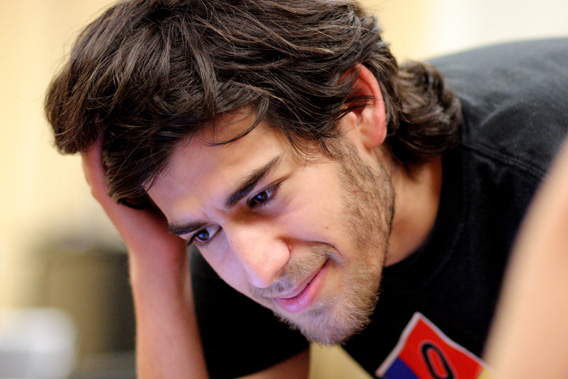
Swartz had his principles, and he held to them forcefully. “Aaron
generally felt like being a stickler about that stuff made the world
better, because it actually pushed people to do the right thing,” says
Wikler. He wouldn’t sign any contracts that might encourage patent
trolling. He was finicky about his wardrobe, wearing T-shirts whenever
possible. “Suits,” he wrote on his blog, “are the physical evidence of power distance, the entrenchment of a particular form of inequality.”
He wasn’t dogmatic about everything. He’d always been opposed to
marriage, but he was starting to think he’d gotten that wrong. On
Friday, Jan. 11, Stinebrickner-Kauffman stopped over at Wikler’s house.
She and Swartz were coming over for dinner later that night, but she
came by herself beforehand. As she played with Wikler’s new baby, she
mentioned that Swartz had told her that, after the case was resolved, he
might consider getting married. If that was possible, anything was
possible.
But less than two miles away, in a small and dark studio apartment, Aaron Swartz was already dead." The Idealist: Aaron Swatz wanted to save the world why couldn't he save himself.
Our first book began as an invitation to reflect on the events of
2011: to make sense of the changes going on in the world and in our own
lives, and to voice the questions the year had left us with.
From Wikileaks to the UK riots, Tahrir Square to Zuccotti Park, the
headline events of the year all make their appearance, often from the
perspective of those involved in or touched by them. Smári McCarthy
writes about his experience as a Telecomix activist providing tech
support to revolutions in Tunisia, Egypt and Syria. Keri Facer examines
her responses after riots come to the street she has just moved into.
But these images sit alongside the less dramatic events that make up the
fabric of our lives, and between the two a pattern begins to emerge.
Then there is register for a free copy of The Open Book global movement for open knowledge. From makerspaces to data wrangling schools to archives, the digital is being remixed by the open – and it is changing society as we know it. New concepts about public information, transparency and the Commons are combining in unprecedented ways, resulting in a breadth of transformative collaborations across the globe.
The Open Book explores the social and technological manifestations of this emergent movement for the first time. It features 25 in-depth thought pieces written by pioneers of openness around the world from London to São Paulo, including the Open Knowledge Foundation’s Rufus Pollock, the Free Software Foundation’s Karsten Gerloff, the Centre for Sustainable Communications’ Jorge Luis Zapico, The Guardian’s Simon Rogers, the Open Hardware Summit’s Catarina Mota, IBM’s Ville Peltola, Open Design Now‘s Peter Troxler and the Harvard Berkman Centre for Internet & Society’s Mayo Fuster Morell.
Each of these contributions explore a unique aspect of the open knowledge movement and how it has affected work, society and culture across paradigms, from government to business to design to education. Also included is “The Evolution of Open Knowledge”, the world’s first crowdsourced timeline of openness and transparency from 1425 to the current day.
The Open Book is an essential reference point for those interested in the culmination of a global movement for change in a time of rapid social progress. The book is a free PDF.
Hacking is nothing new. Some do it for profit, others for secrets.
Self-styled "hacktivist" groups such as Anonymous do it for causes they
believe in. But what if the target is a newspaper and the hackers have a
grudge?
On January 30, the New York Times revealed that hackers
based in China had waged a four-month-long cyber onslaught against the
paper soon after it published an article exposing the fortune amassed by
the family of outgoing premier Wen Jiabao, a fortune that for the
Chinese Communist Party has turned out to be – quite literally – an
embarrassment of riches.
Soon after the Times, the Wall Street Journal and the Washington Post
admitted that they too had been attacked. Bloomberg News and Associated
Press are also on the list of media outlets targeted by China-based
hackers, raising the spectre of a new front in the global cyber war –
one that puts journalists and their sources in the firing line.
The documentary about the founders of the Pirate Bay. Share it with the world! Support the filmmakers of this free film here
www.tpbafk.tv A film by Simon Klose
Simon
Klose, the Swedish documentary and music video maker, wants you to
pirate his film, TPB AFK: The Pirate Bay Away From Keyboard, and he’s
not even kidding. His documentary about file-sharing website The Pirate
Bay is available for sale, on YouTube (free), or via Pirate Bay torrent
(also free).
The documentary covers the stories of Pirate Bay
administrators Fredrik Neij, Gottfrid Svartholm Warg, and Peter Sunde as
they handle their 2009 Sweden court case about civil and criminal
copyright laws. After being convicted, they are then forced to handle
life “away from keyboard”.
Gottfrid Svartholm Warg has been in police custody since 1 September 2012, when he was arrested and later extradited to Sweden from Cambodia. Upon arrival back to Sweden he was immediately arrested for suspicion of
hacking Logica, a Swedish IT company that works with the local tax
authorities. He was kept in solitary for up to 23 hours a day until
December 7, 2012 while serving his one year sentence. The prosecution
kept extending custody and later implicated him in a second hacking case
along with accusations of four instances of serious fraud and four
attempted frauds. Again, no official charges were filed. He remains in custody today.
Eric Schmidt, Executive Chairman of Google (Right) with with the Iranian Foreign Minister (Left).
The Google boss hit the headlines last week when it was revealed he
had co-authored a book criticizing the Chinese authorities. Google has
clashed repeatedly with Beijing over censorship and alleged hacking. Schmidt
called China the world's "most sophisticated and prolific" hacker of
foreign companies, in a book called The New Digital Age, which will be
published in April. The book, co-written with Jared Cohen, a
former state department official who now runs a Google thinktank, brands
China as the world's most dangerous superpower.
Eric Schmidt goes on to sign a 60 million euros deal with the French President Francoise Hollande to be able to link to French publications without having to pay tax on the advertising revenue it earns.
Eric Schmidt spoke recently at the
Centre for Research in the Arts, Social Sciences and Humanities (CRASSH) at Cambridge University. He gave a convincing and intelligent account of what life could be like in a globalized society where connectivity is the steam of a new industrial revolution.
During the series of talks Schmidt claimed that open networks will prevent genocide.
Anonymous' 'Operation Last Resort' has published a new document
revealing that the hacking collective has had an astonishing amount of
access to The Fed's internal files and servers.
The new attack is Anonymous' response to the information security community's anger at the Federal Reserve ("The Fed") for its dismissive attitude and lack of transparency around Sunday's emergency contact system hack.
Anonymous has compromised the Grand Banks Yachts Web site to host this new file—Grand Banks Yachts, Ltd.—which manufactures and sells luxury yachts worldwide. The URL filename ominously reads, "dorner-is-a-symptom-not-the-syndrome."
The Anonymous 'Operation Last Resort' action
last Sunday exposed over 4,600 bank executive credentials for The Fed's
expanding nationwide program, the Emergency Communications System. The FBI has now begin to respond—at
least to the bank hack—by opening a fresh criminal investigation into
Anonymous 'Operation Last Resort.'
It was announced on Wednesday morning that Barrett Brown (pictured), a man who
became a very public talking head for AnonOps (the brain trust that is
arguably the cortex of the hacktivist group Anonymous, even though there
technically isn’t one) is
facing up to 100 years in jail for three separate indictments. -
'Why is Barrett Brown Facing 100 Years in Prison?'
A multinational security firm has secretly developed
software capable of tracking people's movements and predicting future behaviour by mining data from
social networking websites.
A
video obtained by the Guardian
reveals how an "extreme-scale analytics" system created by Raytheon,
the world's fifth largest defence contractor, can gather vast amounts of
information about people from websites including Facebook, Twitter and
Foursquare.
Raytheon says it has not sold the software – named Riot, or Rapid Information Overlay Technology – to any clients.
But
the Massachusetts-based company has acknowledged the technology was
shared with US government and industry as part of a joint research and
development effort, in 2010, to help build a national security system
capable of analyzing "trillions of entities" from cyberspace. (
Guardian)
More from the war for information and access here.
Society has been infiltrated by new digital technologies with potentially profound consequences. It makes sense to ask what’s changed? How has it changed? How much? Researchers and companies have gathered enormous amounts of data to ostensibly answer these questions, but the full implications of this data too often go unexplored. The Web is not a new, separate sphere, but part of the same social reality about which critical social theorists have produced several centuries worth of insight. These theories may be profitably used, tweaked, or even abandoned in light of contemporary realities. What previous theoretical tools help us understand these changes? What new theories should be
created?
The
Theorizing the Web conference seeks to bring together an inter/non-disciplinary group of scholars, journalists, artists, and commentators to theorize the Web. As in the past, we encourage interrogations of power, social inequality, and social justice; intersections of gender, race, class, age, sexual orientation, and disability will be woven throughout the conference.


