Showing posts with label Urban Space. Show all posts

Wednesday, October 16, 2013

Blockholm: Crowdsourcing City Planning with Minecraft


The Swedish Centre for Architecture and Design has announced a project where the topographic site for Stockholm has been reproduced in Minecraft and people are invited to rebuild the city virtually.

Blockholm opens on 24 October and allows people to realize the city they always dreamed of. It is interesting as it allows a form of modelling and design rarely practiced on a large scale in city planning. According to the website (not my translation):


Blockholm - A new Stockholm in Minecraft

In architecture, work is in digital tools and models. What happens when these tools become available to anyone? Maybe we can see where the road will be, the house was to stand. Building a model in three dimensions and show how we think. In Block Holm will all be with. A simple method, the same for all, we can build a new city, block by block. We have cleared the city of all past. There is something scary, yet liberating in to start anew.

How can we change our city?

Can the game be a way to show what we think and what we want? In Blockholm we build all side by side, adult children, our dreams and ideas. Everybody has the same conditions but with different starting points. We can test ideas and forms without preconditions, possible and impossible. We have a new way to have a conversation with each other and with policy makers.

The digital mirror image

- By maintaining the road network, we can orient ourselves in this amazing reflection. The basic structure is the same, but everything is different, says Markus Bohm, artist and project manager:
- We want to create a meeting between the game's realities and current urban planning and architecture. Minecraft has become a great platform for creativity and we want to show new ways of working, new ways to organize.

The world's largest Architecture and Design Projects

Each property in today Stockholm is an identical plot in Blockholm.
- We have generated approximately 100,000 construction sites. It will be the world's largest architecture and design projects in terms of number of participants. We will release district for district to allow the city to emerge piecemeal. All participants will work side by side and see how the city is emerging from within. There is a huge process that anyone can follow. In an interactive map on the internet, the construction of blocks islet seen in real time, says Mats Karlsson, architect and project manager.


Tuesday, October 15, 2013

Abandoned Public Library Detroit 2013

Wednesday, July 24, 2013

Beggar's Notes: Stockholm Summer 2013

In the Swedish capital, Stockholm there is a form of begging that is performed on the metro trains. As far as begging goes it is a very polite and mediated form of the art. A beggar gets in a carriage and quietly places a note on all the spare seats next to sitting passengers. I have been photographing some of these notes. Not as an act of morbid spectatorship, but as an exercise in reporting back on urban space. If these short notes are windows into the tragic lives of others then their meaning is more poignant as parts of the performances that deliver them. Often over-dressed men and women (heavy jumpers, thick jackets on warm summer days) shuffling through crowded train carriages. Few pay attention to these street people, but they do make some money. I often see women giving coins, perhaps moved by the suggestions of suffering children, single mothers and homeless families. The uniformity of the situations reported in these notes -  homelessness, sick children, deceased parents (generally by accidents or political upheavals - never from drink, drugs or domestic violence), suggest that there is a genre of begging notes. However, knowing something of homelessness myself (by choice not necessity and 15 years ago as I roamed the wide world looking for adventure) there are some terrible things that happen to people. I consider these notes part of the urban milieu, a globalized world that is on show in every city street and train carriage. 


The above two notes are from different people but are the same. "Hello dear friend, I help my father more than I can, not to maintain myself with the income I get in Sweden but for us in Rumania. We have no income there is my brother to help me more than I can. God to help. Thanks"

"Hello, I come from Rumania and I have 4 brothers. My mother has a problem with hepatitis. There are also floods in Rumania. We have nowhere to live. Please help me with a little money so I can survive this tragedy. Thanks so much. May God help you."

"Hello! I have a brother. He is 17 years old and is paralyzed. My parents died in a car accident 6 years ago. Please help me with a little money for food and treatment for my brother. Thank you so much and may God help you."

"I am father to two children and one of them has a deadly disease. We have no home. I beg you to help us. I and my children need a home. We thank you for all the help you can give us."

"Hello! I am a poor woman. I have one child and he is sick with leukemia. He needs help for such treatment. Please help me with a little money. Thank you for your help. May God help you. Please give this note back thanks!"

"Hello! Be nice and help me with a little money for transplantation of skin ('hud') for my daughter. It is impossible for me to do without your help. Thanks so much for your help!"

 "Hello! Be nice and help me with a little money for transplantation of skin ('hud') for my daughter. It is impossible for me to do without your help. Thanks so much for your help!"

"Hello! Ladies and gentlemen! Would you be so kind as to help me with a little money. I have 4 children. My daughter is sick and I have no money for operation or medicine. Please help my daughter! Thanks! Gigi.

 Hello! I am from Rumania. My father died in the revolution when Ceausescu fell. I have 4 brothers and we have no social assistance. Please help me and my family with a little change for food (Or if you have some work for me I would be very happy). Thanks for the help! Return the note thanks!

Hello! I am a poor man. I have two children which one is sick with leukemia. He needs help for subsequent treatment. Please help me with a little money. Thanks for the help. May God help you. The note back please!


Hello! My ladies and gentlemen. If it is ok, please help me with a little money because my child (5 months) has leukemia. He needs a transplant operation. May God help you that help my child. Thanks [Two notes, three months apart, same text, different photos].

Hello, These are my children. I am a widow, I have no money to take care of school. I have a problem with my health and no money for medicine. I do not work anywhere and have no social support. Please help me. Thanks a lot!

Monday, June 24, 2013

Game Tour #1 - The Rome of Assassin's Creed Brotherhood


Assassin's Creed Brotherhood - The Game vs Real Photos - Part 1


Assassin's Creed Brotherhood - The Game vs Real Photos - Part 2


In two days I will be traveling to Rome to spend some time wandering around the city with my son. One of the things we are going to do there is seek out the places featured in Assassin's Creed Brotherhood.

Assassin's Creed: Brotherhood is a 2010 action-adventure stealth video game developed by Ubisoft Montreal and published by Ubisoft for PlayStation 3 and Xbox 360. It is the third major installment in the Assassin's Creed series, a direct sequel to 2009's Assassin's Creed II, and the second chapter in the 'Ezio trilogy'. The game was released worldwide for PlayStation 3 and Xbox 360, beginning in North America on November 16, 2010. It was later released for Microsoft Windows in March 2011, followed by an OS X version in May 2011.

The story is set in a fictional history of real world events set in two time periods, the 16th and 21st centuries. The main portion of Assassin's Creed: Brotherhood takes place immediately after the plot of Assassin's Creed II, featuring 16th-century Assassin Ezio Auditore da Firenze in Italy and his quest to restore the Assassin order, and destroy his enemies: the Borgia family. Intersecting with these historical events are the modern day activities of series protagonist Desmond Miles, who relives his ancestor Ezio's memories to find a way to fight against the Assassins' enemies, the Templars, and to prevent the 2012 apocalypse.

Assassin's Creed: Brotherhood is set in an open world and presented from the third-person perspective with a primary focus on using Desmond and Ezio's combat and stealth abilities to eliminate targets and explore the environment. Ezio is able to freely explore 16th-century Rome to complete side missions away from the primary storyline. The game introduced a multiplayer component to the series, portrayed as a Templar training program.
Locations in Assassin's Creed Brotherhood include the Pantheon, the Colosseum, the Passetto di Borgo, the Castel Sant'Angelo and the Cappella Sistina.

 
Tempio di Saturno – the Temple of Saturn, which is present in Assassin’s Creed: Brotherhood 

Outside of the Colosseum in Assassin’s Creed: Brotherhood

The Catacombs
Ezio in the Catacombe di Roma


The Pantheon in Assassin’s Creed: Brotherhood

The original pantheon was built to honour the ancient Roman gods. Literally, it means 'temple of all the gods'. It was, however, destroyed by a huge fire and a new one built in its place approximately 50 years later. It is unknown exactly what the new building was used for, but it was converted to a Christian church in medieval times. This probably accounts for why it is so well preserved. Unlike other buildings from this time, the Pantheon was kept up by the church. It has since been used as a tomb, and many famous people were buried there such as Raphael. It continues to be used as a church to this day, with masses still held regularly.

A Follower of Romulus from Assassin's Creed and the Tempio di Romolo (the Temple of Romulus)

The Piazza del Popolo in Assassin’s Creed: Brotherhood

Piazza del Popolo

"Nothing is True. Everything is Permitted"

Tuesday, May 21, 2013

Alter Bahnhof Video Walk; 2012; Janet Cardiff and George Bures Miller


Here is an attempt to document our 2nd piece made for dOCUMENTA (13). Viewers are given an ipod and headphones and asked to follow the prerecorded video through the old train station in Kassel. The overlapping realities lead to a strange, perceptive confusion in the viewers brain. Hard to document and harder to explain. We only present the recorded audio here, but when doing the walk the real sounds mix with the recorded adding another level of confusion as to what is real and what is fiction. Wear headphones to get the full effect of the original binaural recording.

This is a 6 minute clip of a 26 minute piece. Credits for the entire piece follow.

Thursday, May 16, 2013

HABITUS: Objects, Behaviours, Rooms by Justin Ascott


Habitus' explores - through a creative dialectic - the way human consciousness is shaped by the compartmentalised structures of the places we inhabit -- primarily the home and workplace - and the habituated behaviours we perform within these various nodes. The mechanical actions we carry out each day -- lead to feelings of disillusionment and disengagement with social reality. The only objects and 'tools' that have the transformative power to expand consciousness are those commonly used by shamans in ritualised contexts - to induce altered states of perception for the purposes of healing, transcendence and revelation.

Habitus refers to lifestyle, the values, the dispositions and expectation of particular social groups that are acquired through the activities and experiences of everyday life. Perhaps in more basic terms, the habitus could be understood as a structure of the mind characterized by a set of acquired schemata, sensibilities, dispositions and taste. The particular contents of the habitus are the result of the objectification of social structure at the level of individual subjectivity. The habitus can be seen as counterpoint to the notions of rationality that are prevalent within other disciplines of social science research. It is perhaps best understood in relation to the notion of the 'habitus' and 'field', which describes the relationship between individual agents and the contextual environment.

Pierre Bourdieu elaborates on the notion of Habitus by explaining its dependency on history and human memory. For instance, a certain behaviour or belief becomes part of a society's structure when the original purpose of that behaviour or belief can no longer be recalled and becomes socialized into individuals of that culture.

Friday, May 10, 2013

The Sonic City


On Monday at 1.15 pm in HUMlab at Umeå University Shannon Mattern, Associate Professor at New School, New York will give a seminar on “Hearing Urban Infrastructures: A Sonic Archaeology of the Media-City”. The abstract is:
Abstract: For over a century, scholars and designers have acknowledged the existence of a spatial form commonly known as the “media city,” which encompasses both the modern city as represented through photographs, film, and digital technologies; and the city as shaped by those same technologies. In this seminar I argue for the need to acknowledge the longue durée of the “media city,” and to move beyond ocularcentric models of urban history. Drawing on the growing body of research on infrastructure that’s emerging from across the design fields, and on work in “media archaeology” within my own field of media studies, I’ll argue that we need to “excavate” the deep history of urban mediation, and I’ll take as an example an aspect of the media city that wouldn’t seem to lend itself easily to excavation. I’m referring to the “sonic city” – the city of public address and radio waves and everyday conversation. How does one dig into a form of mediation that seemingly has no physical form? What can we learn about how our cities have functioned as material sounding boards, resonance chambers, and infrastructures for various forms of sonic communication?
I have heard Shannon speak before, have been following her work and have met her as well. This will be a killer presentation for anyone interested in urban space, audio studies, transmediality,  digital media and media archeology. If you are in Umeå or within 500 kms of it I suggest attending in person. For others there will be a live stream open upon the hour; http://live.humlab.umu.se/

Shannon Mattern is an Associate Professor at New School, New York. Her research interest include relationships between the forms and materialities of media and the spaces -- architectural, urban, and conceptual -- they create and inhabit. Additional areas of interest include, generally, media and design history and theory; and, more specifically, media form and materiality; media reception (especially reading) and the spaces in which we store, access and consume media; textual theory; and media and spatial poetics. Shannon keeps a lively blog here: http://www.wordsinspace.net/wordpress/

Friday, September 28, 2012

Russell King Street Art New York


Russell King is a New York based street artist.

More street art from NYC can be seen here.

Tuesday, October 20, 2009

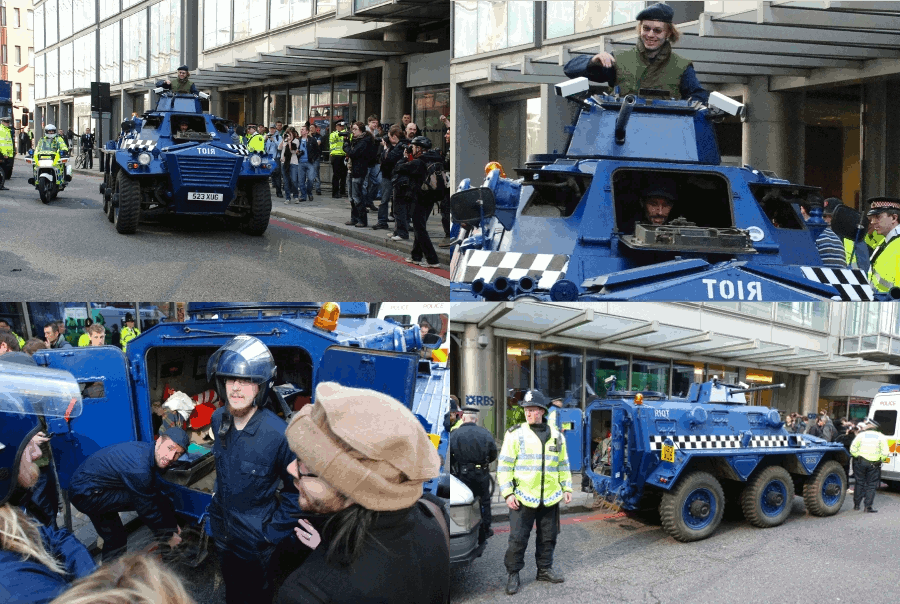
Free the Space Hijackers


“The vehicle, owned by anarchist pranksters the Space Hijackers, bore a number of fake CCTV cameras bolted onto its turret, a plastic pipe with holes in it for a gun and a bumper sticker that read “How Do You Like My Driving? 0800 F**K YOU”. It blared Wagner’s Ride of the Valkyries from a sound system. If you can show me a police force that does all that, I can show you a police force on acid.” Leah Borromeo
Continental Drift

Wednesday, May 06, 2009

Awesome

Wednesday, April 29, 2009

There Goes the Neighbourhood


As I have written here before, between 1995 and 1999 Redfern in Sydney was my home in the world. An amazing neighborhood that centered around The Block, the property of the Redfern Aboriginal Housing Company. In Redfern a lot of artists, musicians and activists made their lives in a fashion that was more often than not cooperative and autonomous. I have written down some of my recollections of the period 1995-97 in Redfern here, when the threat of gentrification, the heavy police presence and the social problems (including uncontrolled hard drug use) where eating away at the sense of community that I found when I first came to The Fern in 1994.

"The Block, Redfern, has been described as the "Black Heart" of Australia and occupies a unique place within Sydney's urban landscape as a centre for the Indigenous community. It was the site for the Aboriginal Tent Embassy, and has been the gathering point for many protests and community events. Just minutes from the second busiest train station in Sydney are the open camp fires and communal use of public space of the community on The Block." Critical Spatial Practice


Today the exemplary blog, Critical Spatial Practice has published an account of the art exhibition There Goes The Neighbourhood along with a short essay on The Politics of Urban Space:

There Goes the Neighbourhood is an exhibition, residency, discussion and publishing project for May 2009. The central element of this project will be an exploration of the politics of urban space, with a focus on Redfern, Sydney. The project will examine the complex life of cities and how the phenomenon of gentrification is altering the relationship between democracy and demography around the world. While urban change itself is not always a bad thing, gentrification often happens at an accelerated rate, out pricing the lower income and marginalized communities from the neighbourhood and dislocating them from their existing connections to urban space. The project brings together artists from Australia and around the world whose work addresses these issues.


There Goes the Neighbourhood is also a 132 page book, that can be downloaded as a PDF from the website.

Saturday, January 17, 2009

Mission Accomplished


The streets of Baghdad are now safe.


From Subtopia

Tuesday, September 04, 2007

Smooth/Striated Sydney


The appropriation and modification of space in Sydney for the APEC summit this week has moved into a new stage. It started with the closing off of spaces, restriction of visual access to key areas that will be inhabited by power over the next few days. Now the spaces around these key points are being striated to prevent movement, assembly and ultimately dissent. What has been described as Fortress Sydney is an interesting example of urban space being 'remixed' in quantitative terms, segmented to allow for altered flows or for no flow at all. Once the 'security' and 'protesters' meet in this space (defined only by the 'security' side of the exchange) we will see the meaning of the space be played out. I hope no one gets hurt.

Tuesday, May 08, 2007

Modalities of Space in Video and Computer Games

With a nice chapter on narrative space.

Axel Stockburger
Abstract:
This thesis focuses on the novel spatial paradigms emerging from computer and video games. It aims to develop an original theoretical framework that takes the hybrid nature of the medium into account. The goal of this work is to extend the present range of methodologies directed towards the analysis of digital games. In order to reveal the roots of the spatial apparatus at work an overview of the most significant conceptions of space in western thought is given. Henri Lefebvre’s reading of space as a triad of perceived, conceived and lived space is adopted. This serves to account for the multifaceted nature of the subject, enables the integration of divergent spatial conceptions as part of a coherent framework, and highlights the importance of experiential notions of spatiality. Starting from Michel Foucault’s notion of the heterotopia, game-space is posited as the dynamic interplay between different spatial modalities. As constitutive elements of the dynamic spatial system mobilized by digital games the following modalities are advanced: the physical space of the player, the space emerging from the narrative, the rules, the audiovisual representation and the kinaesthetic link between player and game. These different modalities are examined in detail in the light of a selected range of exemplary games. Based on a discussion of film theory in this context an original model that serves to distinguish between different visual representational strategies is presented. A chapter is dedicated to the analysis of the crucial and often overlooked role of sound for the generation of spatial illusions. It is argued that sound has to be regarded as the privileged element that enables the active use of representational space in three dimensions. Finally the proposed model is mobilised to explore how the work of contemporary artists relates to the spatial paradigms set forth by digital games. The critical dimension of artistic work in this context is outlined. The thesis concludes with a discussion of the impact of the prevalent modes of spatial practice in computer and video games on wider areas of everyday life.

Thursday, January 25, 2007

Graffiti Research Lab


The Graffiti Research Lab is dedicated to outfitting graffiti writers, artists and protestors with open source tools for urban communication. The goal of the G.R.L. is to technologically empower individuals to creatively alter and reclaim their surroundings from commercial and corporate culture. G.R.L. agents are currently working in the lab and in the field to develop and test a range of experimental technologies for the state-of-the-art graffiti writer.This site documents those efforts with video documentation and DIY instructions for each project.